
TL;DR
MCP (Model Context Protocol) is an open standard that lets AI agents connect to any tool or data source. Learn how it works, why it matters, and how to use it.
Your AI agent can write code, summarize documents, and draft emails. But the moment you ask it to pull data from your CRM, update a database, or query your internal wiki, things fall apart. Every tool needs a custom integration. Every new large language model means rebuilding everything from scratch.
The Model Context Protocol (MCP) fixes this. It's the reason Cloudflare, OpenAI, Google, and Microsoft all converged on the same open protocol within 12 months. It's the reason the Linux Foundation created an entire foundation to govern it. And it's the reason 17,000+ MCP servers now exist in the public ecosystem.
If you build AI applications, deploy AI agents, or make technology decisions for your organization, MCP is the standard you need to understand. This guide covers what it is, how it works, why it matters, and where it's headed.
What Is MCP?
The Model Context Protocol (MCP) is an open standard that creates a standardized way for AI applications to communicate with external tools, data sources, and services. Introduced by Anthropic in November 2024, MCP is now governed by the Linux Foundation's Agentic AI Foundation and has been adopted by every major AI platform.
Think of MCP as the USB-C of AI. Before USB-C, every device had a different charger. Lightning, micro-USB, proprietary connectors. It was a mess. USB-C created a universal standard: one cable, any device. MCP does the same thing for AI agents and the tools they interact with. Build one MCP server, and any compatible large language model can use it.
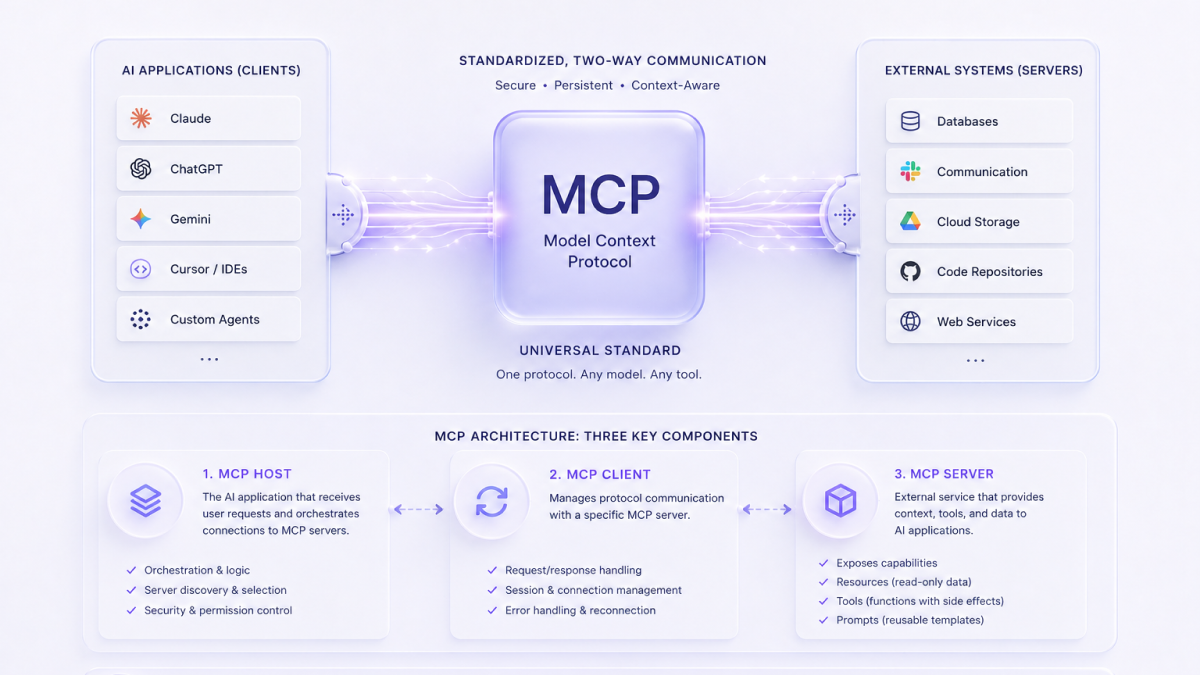
The protocol defines a two-way communication channel between AI applications (called "clients") and external systems (called "servers"). Unlike one-way tool calls, MCP supports persistent connections, dynamic tool discovery, and real-time data streaming. This standardization layer is what makes AI agents context-aware.
The One-Sentence Definition
MCP is an open standard that lets AI agents securely connect to any tool or data source through a universal interface, eliminating the need for custom integrations per model or per vendor.
How MCP Works: The Architecture Explained
MCP implements a client-server architecture with three key components. Understanding these components is essential to grasping how the Model Context Protocol standardizes AI tool integration.
The MCP Host
The host is the AI application that receives user requests and seeks access to context through the MCP. It could be Claude Desktop, a custom AI agent, an IDE like Cursor, or any application that needs to interact with external tools. The host contains the orchestration logic and manages which MCP servers to connect to while enforcing security policies.
The MCP Client
The client exists within the host and handles protocol-level communication with a specific MCP server. It converts user requests into a structured format that the open protocol can process. A single host can maintain multiple clients, each with a one-to-one relationship with an MCP server. The client manages request/response parsing, error handling, and session lifecycle including timeouts and reconnections.
The MCP Server
The server is the external service that provides context to the large language model by converting user requests into server actions. It exposes the tool's capabilities (like "search database," "send email," or "read file") in a format the AI model can understand. MCP servers expose data through three core primitives: resources (read-only data), tools (functions with side effects), and prompts (reusable templates for common tasks).
What Happens Under the Hood
Here's the flow when you ask your AI agent to "look up my next meeting and draft a response":
- The large language model receives your request
- The host identifies which MCP server handles calendar access
- The client sends a request to the calendar MCP server: "List upcoming events"
- The MCP server calls Google Calendar's API, gets the data, and formats it
- The response flows back to the model through the JSON-RPC 2.0 transport layer
- The model drafts a response using the meeting details
- The client sends another request: "Draft an email to the meeting organizer"
- The MCP server calls Gmail's API to send the draft
All of this happens through a single, standardized protocol. No custom code. No vendor-specific integrations. No M×N integration complexity.
MCP vs Function Calling vs APIs: What's the Difference?
People often confuse the Model Context Protocol with function calling or traditional APIs. They solve related but different problems in AI agent tool integration.
Function Calling
Function calling lets an LLM decide what tool to use and when to call it. You define functions in your code, and the model selects the right one based on the user's request. But function calling is vendor-specific (OpenAI's format differs from Anthropic's) and static (you hardcode which tools are available).
Traditional APIs
APIs let software systems talk to each other. They're well-established, widely supported, and battle-tested. But traditional APIs require custom integration code for every new connection. If you want your AI agent to access 10 different tools, you write 10 different integrations. Switch models? You might need to rewrite them.
MCP
MCP combines the best of both worlds. Like function calling, it lets large language models discover and use tools dynamically. Like APIs, it provides a standardized communication layer. But unlike either, it's model-agnostic (works with Claude, GPT, Gemini, Llama, or any compatible LLM) and vendor-neutral (governed by the Linux Foundation, not any single company).
MCP doesn't replace APIs. It sits on top of them. An MCP server wraps an existing API and exposes it in a format that any AI model can consume. Your REST endpoints, GraphQL queries, and database connections stay exactly where they are.

A Brief History of MCP
November 2024: Anthropic Launches MCP
Anthropic open-sourced the Model Context Protocol with a simple proposition: AI models need a standard way to connect to data and tools. Claude Desktop was the first host, and a handful of reference servers demonstrated the concept.
Early 2025: The Ecosystem Ignites
Within months, the MCP ecosystem exploded. MCP server downloads grew from roughly 100,000 in November 2024 to over 8 million by April 2025 (Source: Deepak Gupta). OpenAI added MCP support to ChatGPT in March 2025. Google followed with Gemini support. Microsoft announced MCP compatibility across Azure AI.
The protocol was no longer Anthropic's project. It had become the industry standard for AI agent tool integration.
Mid-2025: Enterprise Adoption Begins
Companies started deploying MCP servers in production. Cloudflare launched remote MCP hosting. Workato released production-ready MCP servers for enterprise AI automation. The Linux Foundation announced MCPCon, a global conference series dedicated to the Model Context Protocol.
November 2025: First Anniversary
The MCP specification reached its one-year anniversary with a major update. The protocol had become what Thoughtworks called "one of the key stories of 2025" in enterprise AI.
December 2025: Anthropic Donates MCP to Linux Foundation
Anthropic donated MCP to the Linux Foundation's new Agentic AI Foundation, alongside Block's goose project. This cemented the Model Context Protocol as a truly open, community-governed standard with no single vendor in control.
2026: The Enterprise Year
By early 2026, MCP adoption grew over 400% year-over-year with more than 5,000 MCP servers publicly available on GitHub. Over 17,000 MCP servers are now listed publicly (Source: Zuplo). CIO Magazine called it "suddenly on every executive agenda." The protocol was no longer optional for enterprise AI.
Why MCP Matters for Enterprise AI
The Integration Tax
Every time you add a new AI tool to your stack, you pay an integration tax. Custom connectors, authentication flows, data format conversions, error handling, monitoring. For a single tool, it's manageable. For an enterprise AI platform connecting to 20, 50, or 100 systems, the tax becomes crippling.
MCP eliminates the integration tax by solving the classic M×N problem. Instead of building M×N integrations (models times data sources), you build one MCP server per tool. Any model, any host, any use case can connect to it. The integration cost drops from O(M × N) to O(M + N).
Model Freedom
When your tools are connected through the Model Context Protocol, switching large language models becomes trivial. Want to test whether Claude handles your customer support queries better than GPT? Change the model configuration. Your MCP servers stay exactly the same.
This is the enterprise equivalent of what Apple announced at WWDC 2026 for consumer devices: let users choose their AI model. MCP makes that choice possible for enterprises, too.
Security and Governance
MCP doesn't mean "anything goes." The protocol supports authentication (OAuth 2.0), authorization, encrypted communication, and audit logging. Enterprise MCP deployments can enforce per-tool access controls, rate limiting, and data classification policies.
As Qualys reported in 2026, the security challenge isn't MCP itself but the shadow MCP servers that teams deploy without IT oversight. The solution isn't to block MCP, but to provide a governed platform where teams can deploy MCP servers safely.

MCP Server Architecture: A Deep Dive
What Is an MCP Server?
An MCP server is a lightweight program that wraps a tool or data source and exposes its capabilities through the Model Context Protocol. It translates between the standardized MCP interface and the tool's native API.
For example, a GitHub MCP server might expose these capabilities:
- Tools: Create issue, list pull requests, search code, merge PR
- Resources: Repository contents, commit history, branch list
- Prompts: Code review template, PR description generator
The large language model doesn't need to know anything about GitHub's REST API. It just calls the MCP tools in plain language.
Types of MCP Servers
Local MCP servers run on the same machine as the host application. They communicate via standard input/output (stdio), which works best for integrating local resources. This is common for developer tools like file system access, local databases, or IDE integrations.
Remote MCP servers run on separate infrastructure and communicate over HTTP with Server-Sent Events (SSE). This is the pattern for enterprise deployments, where the MCP server connects to cloud services, SaaS platforms, or internal APIs.
Streamable HTTP MCP servers use the newer transport specification that combines the simplicity of HTTP with the real-time capability of SSE. This is becoming the standard for production AI agent deployments.
Popular MCP Servers in 2026
The MCP ecosystem now includes servers for virtually every major platform:
- Database servers: PostgreSQL, MySQL, MongoDB, Redis
- Cloud servers: AWS, Google Cloud, Azure
- Productivity servers: Slack, Notion, Google Drive, Microsoft 365
- Development servers: GitHub, GitLab, Jira, Linear
- Communication servers: Gmail, Outlook, Discord, Telegram
- Data servers: Snowflake, BigQuery, Databricks
Each server follows the same protocol, so a single AI agent can connect to all of them simultaneously through the standardized communication layer.

How MCP Enables AI Agents
From Chatbots to Autonomous Agents
Traditional chatbots follow a simple pattern: user sends a message, model generates a response. They can't take actions, access real-time data, or interact with external systems.
AI agents change this. An agent can plan, reason, use tools, and take autonomous actions to accomplish goals. But agents need tools to be useful, and tools need to be accessible. The Model Context Protocol is the standardization layer that makes tools accessible to agents at scale.
The Modern Agent Stack
Here's what a typical agentic AI stack looks like in 2026:
- Model layer: Claude, GPT, Gemini, or open-source LLMs providing reasoning
- Orchestration layer: Agent framework managing planning, tool selection, and execution
- Protocol layer: MCP connecting the agent to its tools
- Tool layer: MCP servers wrapping databases, APIs, SaaS platforms, and internal systems
- Governance layer: Authentication, authorization, audit logging, and monitoring
Without MCP, the protocol layer is a mess of custom integrations. With MCP, it's a clean, standardized, auditable connection between the agent and its tools.
MCP Security: Risks and Best Practices
MCP's power comes with real security responsibilities. The NSA published security design considerations for the Model Context Protocol in 2026. Here are the key risks and how to address them.
Tool Poisoning
A malicious MCP server can describe its tools in misleading ways, tricking the AI model into performing unintended actions. For example, a server might claim a tool "reads data" when it actually modifies it.
Mitigation: Vet MCP servers before deployment. Use trusted registries. Implement tool description auditing.
Prompt Injection via MCP
Attackers can embed malicious instructions in data returned by MCP servers, attempting to override the model's behavior. If an MCP server returns data from an untrusted source, that data could contain hidden prompts.
Mitigation: Sanitize data from MCP servers before passing it to the model. Implement content filtering. Use sandboxed execution environments.
Shadow MCP Servers
Qualys identified this as the biggest enterprise risk: teams deploying unauthorized MCP servers without IT oversight. These "shadow" servers create ungoverned connections between AI models and sensitive data.
Mitigation: Provide a governed MCP platform. Make it easier to do the right thing than the wrong thing. Centralize MCP server deployment through an approved catalog.
Overbroad Permissions
MCP servers granted excessive permissions can access more data than they need. A calendar server with write access to the entire organization's email is a liability, not a feature.
Mitigation: Implement least-privilege access. Each MCP server should have the minimum permissions required for its function. Use per-client consent for third-party authorization.
MCP vs A2A: Understanding the Protocol Landscape
Google's Agent-to-Agent (A2A) protocol launched in April 2025, leading to confusion about how it relates to the Model Context Protocol.
They solve different problems:
- MCP connects AI agents to tools and data sources. It answers: "How does my agent access a database, send an email, or read a file?"
- A2A connects AI agents to other AI agents. It answers: "How does my agent delegate a task to another agent, coordinate multi-step workflows, or negotiate with peer systems?"
They're complementary, not competing. A well-architected agentic AI system uses MCP for tool access and A2A for agent collaboration. Think of MCP as the agent's hands (how it interacts with the world) and A2A as the agent's voice (how it communicates with other agents).
Real-World Enterprise Use Cases
Customer Support Automation
An AI agent connects to your ticketing system (Zendesk MCP server), knowledge base (Notion MCP server), and customer database (PostgreSQL MCP server). When a customer submits a ticket, the agent searches the knowledge base for relevant articles, checks the customer's history in the database, and drafts a response. A human agent reviews and approves.
Cloudflare deployed this pattern internally and saw employees across product, sales, and finance building governed MCP workflows within weeks.
Data Analytics and Business Intelligence
A data analyst asks their AI agent: "Show me the revenue trend for Q1 compared to last year, broken down by region." The agent connects to Snowflake (via MCP), runs the query, visualizes the results, and generates a summary. No SQL knowledge required. No CSV exports. No waiting for the data team.
DevOps and Incident Response
An on-call engineer asks their AI agent: "What's causing the latency spike on our API?" The agent connects to Datadog (MCP), checks recent deployments via GitHub (MCP), queries error logs from Elasticsearch (MCP), and presents a root cause analysis with recommended fixes.
Compliance and Audit
A compliance officer asks: "Pull all customer data access logs from the last 30 days and flag any unusual patterns." The agent connects to your access control system, audit log database, and SIEM platform, all through MCP servers, and produces a compliance report.

How Odin Uses MCP
Odin was built on the Model Context Protocol from day one. Every AI agent in the Odin platform connects to tools, data sources, and systems through MCP. This means:
- Any model works. Use Claude for writing, Gemini for analysis, or open-source LLMs for cost-sensitive workloads. The MCP connections stay the same.
- Any tool connects. CRM, ticketing, databases, custom APIs. If it has an API, Odin can wrap it in an MCP server.
- Any deployment works. Odin Cloud, private cloud, on-premises, or air-gapped. MCP's standard transport works across all of them.
The result is a platform where enterprises can compose their AI stack from the best components for each use case, without vendor lock-in or integration nightmares.

The Future of MCP
Protocol Evolution
The MCP specification continues to evolve. The June 2025 spec update added streamable HTTP transport, improved authentication, and better streaming support. Future updates will likely address multi-agent coordination, advanced security primitives, and performance optimization.
Enterprise Governance
As MCP adoption matures, enterprise governance tools are following. Platforms are emerging that provide centralized MCP server catalogs, automated security scanning, usage analytics, and compliance reporting. This is the infrastructure that turns the Model Context Protocol from a developer tool into an enterprise platform.
The Agentic AI Foundation
With MCP now under the Linux Foundation's Agentic AI Foundation, the protocol has the institutional backing to become a true industry standard. The foundation includes Anthropic, Block, Google, Microsoft, OpenAI, and other major players. MCP's governance is no longer dependent on any single company.
MCP and Private AI
As more organizations deploy AI on-premises or in air-gapped environments, the Model Context Protocol becomes the bridge between private AI models and internal tools. A government agency can run Llama on isolated infrastructure, connect to classified databases via MCP servers, and get the benefits of agentic AI without exposing data to external services.
Getting Started with MCP
If you're ready to start using the Model Context Protocol, here's the practical path:
For Developers
- Read the specification: modelcontextprotocol.io has the full spec, quickstart guides, and tutorials
- Try the reference servers: GitHub's modelcontextprotocol/servers repo has working examples for common tools
- Build your first server: Start with a simple tool you use daily (file system, database, or API) and wrap it in an MCP server
- Connect to a host: Test your server with Claude Desktop, Cursor, or any MCP-compatible host
For Enterprises
- Audit your current integrations: Map out which AI tools connect to which systems. Identify the integration tax you're paying.
- Identify high-impact candidates: Which tools would benefit most from standardized MCP connections? Start there.
- Build a governed platform: Don't let shadow MCP servers proliferate. Create an approved catalog with security scanning, access controls, and monitoring.
- Measure outcomes: Track resolution rates, cost per interaction, and time savings. MCP's value shows up in business metrics, not technical ones.
Frequently Asked Questions
Sources
- Anthropic. "Introducing the Model Context Protocol." November 25, 2024.
- Anthropic. "Donating the Model Context Protocol and establishing the Agentic AI Foundation." December 9, 2025.
- Model Context Protocol. "One Year of MCP: November 2025 Spec Release." November 25, 2025.
- Zuplo. "The State of MCP: Adoption, Security and Production Readiness." 2026.
- Deepak Gupta. "Model Context Protocol (MCP): Enterprise Adoption Guide." December 2025.
- CIO Magazine. "Why Model Context Protocol is suddenly on every executive agenda." February 24, 2026.
- CData Software. "2026: The Year for Enterprise-Ready MCP Adoption." December 2025.
- Cloudflare. "Scaling MCP adoption: Our reference architecture." April 14, 2026.
- Qualys TotalAI. "MCP Servers: The New Shadow IT for AI in 2026." March 19, 2026.
- NSA. "Model Context Protocol (MCP): Security Design Considerations for Enterprise Deployment." 2026.
- Thoughtworks. "The Model Context Protocol’s impact on 2025." December 11, 2025.
- Google Cloud. "What is Model Context Protocol (MCP)? A guide." 2025.
- Checkmarx. "11 Emerging AI Security Risks with MCP." November 25, 2025.
- IBM. "What is Model Context Protocol (MCP)?" 2026.
- Machine Learning Mastery. "The Complete Guide to Model Context Protocol." October 29, 2025.
Odin AI is an enterprise AI agent platform. Learn more at getodin.ai. Market data and statistics cited in this article are sourced from independent research firms and publicly available reports as of June 2026. Claude, Anthropic, OpenAI, Google, Microsoft, Cloudflare, and all other brand names mentioned are trademarks of their respective owners. Odin AI is not affiliated with any platforms referenced in this analysis.
Still have questions?
Get a live demo with an Odin AI solutions engineer — they'll build an AI agent for your specific workflow on the call.
Book a DemoYou might also like
 Engineering
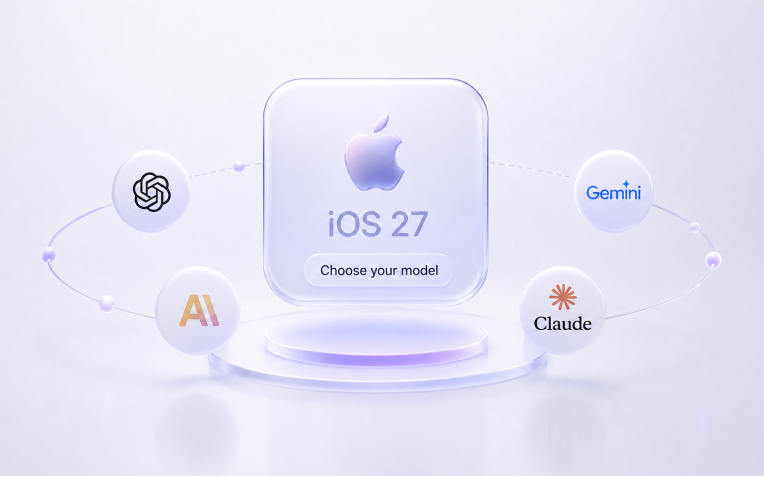
Apple Just Made Model Choice a Feature. Enterprises Have Been Demanding It for Years.
Apple's iOS 27 lets users pick their AI model. Enterprises have needed this freedom for years. MCP and flexible deployment are reshaping enterprise AI.
 Engineering
Tokenmaxxing Is Burning Your AI Budget. Here's How to Kill It.
Tokenmaxxing is the practice of treating AI token consumption as a proxy for productivity: the more tokens your agents burn, the more productive they seem. Uber exhausted its entire 2026 AI budget by April.